The Flower Guild — From Case Study to App store
- Noelia - Yukuri

- Aug 30, 2022
- 4 min read
Updated: Oct 14, 2022
Flower Guild is a local business that has developed an application to make life easier for its customers. Using this service, they can order bouquets and floral arrangements for loved ones and preview them before sending them.
Throughout this case study, I will present the research and testing that led me to the design decision.

The Challenge
The users want to send bouquets to their loved ones or coworkers. Unfortunately, they do not have the time to go to the florist, or they live in another city. There is sometimes a difference between the bouquet they see on the website and what they receive. They are therefore interested in choosing and reserving bouquets quickly and easily from a florist, and viewing the bouquet preview at any time.
The Goal
To design an incredibly simple way to find the floral bouquet that matches a customer's needs.
My Design Process
I followed IDEO’s Human-Centered Design Thinking process to ensure that my design decisions were supported by user research and feedback.

Research Plan
To better understand the habits, desires, pain-points and highlights of users who wish to buy and send bouquets to their loved ones.
Preparing an interview outline and a research plan was the first step. The questions were open-ended, and I avoided any terminology that would lead to conclusions. My primary research goals are outlined below.
Understand the experience of online shopping for the users with the competitors apps.
Identify problems and frustrations they face when shopping online
Identify the top three important features users prefer during online shopping
The following are the pain points I identified after this research.
Pain Points
No time Users do not have time or live in another city, so they cannot go to the florist to choose the bouquet.
Delivery issues Users often discover that the bouquet they see on the website and what they receive is nothing like what they ordered. This is because the bouquet does not arrive on time or the order is canceled at the last minute.
Stock problems Customer arrives at the florist and discovers there are no fresh flowers available or the bouquets have run out.
Little variety Users do not find a wide variety of flowers.
Based on this information I create personas to help me emphasize more with the user and their needs and frustations.

Competitive Audit
A competitive audit was conducted, focusing on the online shopping experiences of competitors. By doing this, I gain some insight into the areas I should start working on, so that I can build a better product.
Ideate
Keeping all this information in mind, I proceed to a brainstorming session. In my analysis, I focused on a few different approaches to how the app should look, what features it should have, and how users should browse and find products.

Low-Fi Wireframes
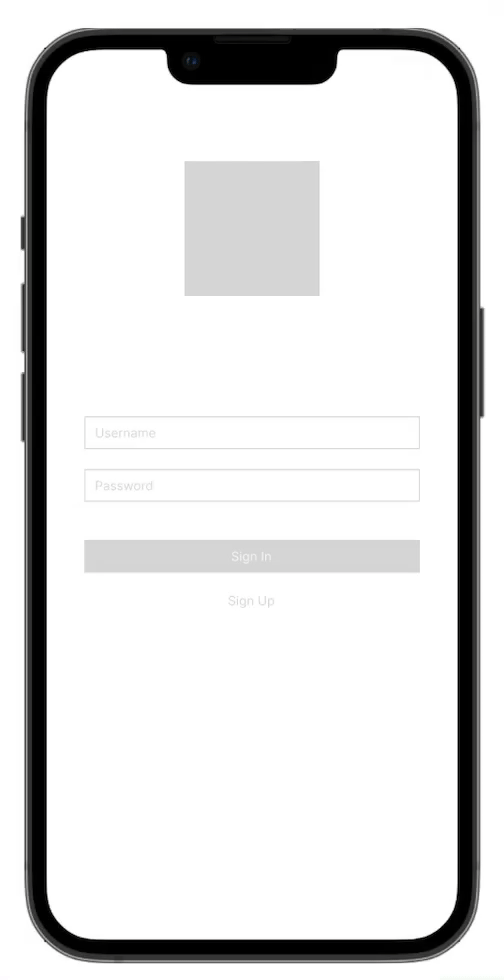
I sketched the lo-fi wireframes on Figma. This is a rought concept of interactions a user will perform on the screen and the basic UI elements that will be covered.
I kept a classic user flow to facilitate navigation for less experienced users, so I decided to keep a fixed navbar.
This is a very important step that I could use to once again review my user flow before prototyping. This also allowed me to quickly visualize the features before starting the Hi-fi design.
Usability Study
To determine whether users encountered any inconveniences in the process of creating a bouquet, writing a card, and making payment, I conducted a usability test. For this purpose, I conducted an unmoderated usability study with 5 participants: 2 males and 3 females between the ages of 24 and 60.
After conducting this usability test, I identified the following findings
4 out of 5 participants think the premade option wasn't clear enough
3 out of 5 participants couldn't find the address change option on the checkout.
4 out of 5 participants find the Home screen overwhelming with to many options
2 out of 5 participants were not English speakers and would like a translation option.
3 out of 5 participants would like to have more customization options.
3 out of 5 participants didn't understand the categories sections.
Refining the design: Hi-fi prototype
I started working on the Hi-fi prototype based on the results of the usability test. In order to keep the app easy to navigate, I wanted to keep the design simple. By creating a Design System I was able to maintain a constant connection. This made the process much faster and prevented me from making small mistakes that would prevent me from moving forward.

According to the usuability study, some users found the home page cluttered. As a result, I decided to simplify the options.

Participants in the usability test express a desire to change the language of the application. This option has been added to the user profile to facilitate accesibility.

High-fidelity prototype

It is essential to design a seamless user flow and enable easy multi-decision making for an on-the-go audience. I translate user-friendly interface designs into intuitive, frictionless experiences.
This mobile app is designed to keep the user experience as simple and familiar as possible while presenting them with a reasonable variety of options. Transparent pricing keeps customers focused on the inputs that matter most to them. Ordering was optimized for efficiency by streamlining browsing and buying.
Next Steps
Developing and testing the app are the next steps. Watch how users interact with The Flower Guild's new mobile platform. It is primarily to gather feedback and see if new features are needed, but opportunities exist to see how our mobile app is adding value and what can be improved.
Opportunities
My next steps are to create a complete purchase flow with order history, add a comment section on the bouquets to help customers choose the one that's right for them, and add more features to the search mode.
Learnings
Research and iterate diligently throughout the design process. Successful design relies on a process-driven approach.
Be open to constructive criticism, fail fast, and iterate based on feedback.
Establish a priority list for your design tasks. Things will always need to be done. Decide together with your stakeholders what the most critical things are.
An innovative solution is born out of a deep understanding of the user problem and critical thinking. Focus on the user problem first and innovative solutions will follow.
Thanks for reding


Comments